Non‐Gaussian tail in the force distribution: a hallmark of correlated disorder in the host media of elastic objects
Jazmín Aragón Sánchez, Gonzalo Rumi, Raúl Cortés Maldonado, Néstor René Cejas Bolecek, Joaquín Puig, Pablo Pedrazzini, Gladys Nieva, Moira I. Dolz, Marcin Konczykowski, Cornelis J. van der Beek, Alejandro B. Kolton & Yanina Fasano
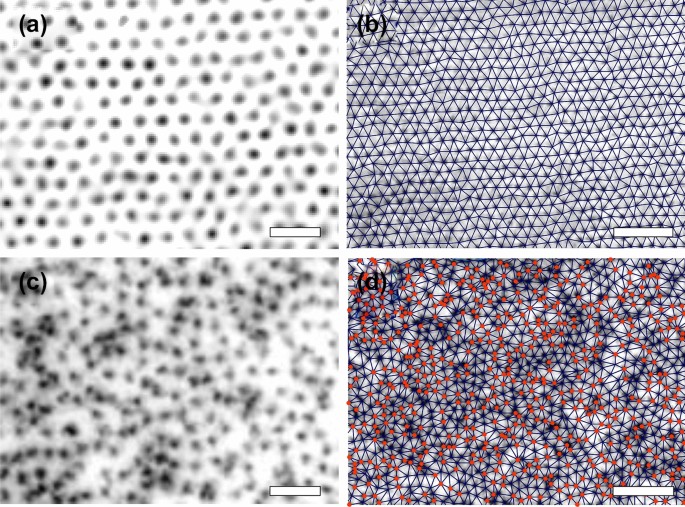
Inferring the nature of disorder in the media where elastic objects are nucleated is of crucial importance for many applications but remains a challenging basic-science problem. Here we propose a method to discern whether weak-point or strong-correlated disorder dominates based on characterizing the distribution of the interaction forces between objects mapped in large fields-of-view. We illustrate our proposal with the case-study system of vortex structures nucleated in type-II superconductors with different pinning landscapes. Interaction force distributions are computed from individual vortex positions imaged in thousands-vortices fields-of-view in a two-orders-of-magnitude-wide vortex-density range. Vortex structures nucleated in point-disordered media present Gaussian distributions of the interaction force components. In contrast, if the media have dilute and randomly- distributed correlated disorder, these distributions present non-Gaussian algebraically-decaying tails for large force magnitudes. We propose that detecting this deviation from the Gaussian behavior is a fingerprint of strong disorder, in our case originated from a dilute distribution of correlated pinning centers


Comments
Post a Comment